Monday, February 9, 2015

Grumman Sport Boat

Grumman Sport Boat

I recently purchased a Grumman Sport boat that I found for a nice price.   The boat has quite a reputation in the North woods, Canada, and Alaska.  This is due to its light weight, and ability to haul stuff like moose.  Interestingly they are rarely seen and hard to find in the South, yet fit the bill perfectly for the type of fishing I enjoy.  

While hunting around trying to find a boat that would fit my needs my Dad told me about the sport boat that he had seen many years ago.  It belonged to Sonny Stoddard, a wonderful outdoorsman who lived nearby.  My Dad seemed to have quite a feeling for that old boat, and after doing a little research I could see why.  

The boat I bought is most similar to a heavy duty square stern Gheenoe, except it is made from aluminum instead of fiberglass.  The boat is 15 feet long with a 43 inch beam. It has oar locks and could also be sailed.  Right now it is rigged with an old two stroke Johnson 3hp outboard, but I will likely upgrade to 6 or 7 hp four stroke at some point.  


I don’t want to add too much to the boat, and would prefer to keep it relatively plain.  My favorite fishing waters almost demand simplicity due to their ruggedness.  Some accessories I would like to add though would be a depth finder, trolling motor, and a swivel seat.  

Like any boat the Grumman has its drawbacks.  It has no drain plug in the bottom, and while stable it does rock more than a jon boat would.  A casting deck on the bow is not practical.  The boat will not take rough seas, and  while it could be rowed rather easily, the boat would be a pure nightmare to paddle long distances or in heavy chop.

What I like about the boat though is that I believe it is a perfect compromise between an aluminum jon boat and fiberglass gheenoe.   The Aucilla River off Florida’s gulf coast is shallow, tidal, and slap full of rocks.  It’s also full of redfish and trout, and I believe the Grumman would excel there.  The Ochlocknee River while not really rocky, is full of blown down logs that require jumping, sliding under, or just ramming through.  The narrow profile and heavy duty bow are perfect for this.

This boat also works for small lakes and farm ponds.  The light weight of the boat makes it hassle free and convenient to slide into the water, no boat ramp needed.  I took my daughter out in it after church on Sunday, and she caught her first bass.


The Grumman Sport Boat has gone through a few changes over the years mostly due to government regulation.  Robb White, a Georgia boat builder, wrote an interestingly article on this here.  Mine is a new model, and I’m looking forward to many years and fishing trips with the boat.  

Saturday, January 25, 2014

CASTING & BLASTING


CASTING & BLASTING

I’ve had an exciting and busy week.  On Monday I headed south to fish Ochlocknee Bay for redfish and trout, and then this Saturday I took advantage of a wood duck hole I had been watching all year.  I had mixed results, but had a ball casting and blasting.

My history with Ochlocknee Bay is a mixed bag.  I’ve had a lot of success toward the mouth of the bay at Bald Point and to the east in Oyster Bay, but the back of Ochlocknee Bay has always been a challenge for me.  There are fish there and people do catch them, but so far, I’m not one of those people. 


I arrived early Monday morning and found a deep hole around 35 feet to fish.  The hole was just off the end of the seldom used boat ramp from which I launched my kayak.  I fished with cut mullet and shrimp, and managed just a single sheephead.  These fish are fun and tasty, but not what I was after.  After striking out at my hole, I paddled up and down the bay, but never found the fish. 

My results this Saturday were much better.  I have a honey hole that wood ducks have been pouring into all winter.  I had purposely not hunted there just saving it for the last day of the season.  I was able to convince my brother and a few friends to sneak back there with me and wack em’. 

The morning was cold, but productive.  We arrived at the hole thirty minutes before daylight, and waited patiently.  Sure enough, the ducks soon began to pour in.  They arrived in groups of three up to ten.  The hunt didn’t last long, but we were able to find eight dead woodies between the four of us.  All in all a great morning. 


Wednesday, January 22, 2014

Controlled Burns: A Family Tradition


Controlled Burns: A Family Tradition

Burning the pine woods where I grew up was always a family event involving my parents, grandparents, brother, aunts and uncles.  One of my earliest memories is of my brother and I riding in the back of my grandaddy’s truck checking on fires.  We would bump along the plowed fire break, jump off the back of the tailgate, and then run to jump back on.  To eight year old this was big fun.  I also remember walking along enviously behind my Dad as he would set fires with a drip torch.  The wiregrass would flame up easily and begin to creep toward more of its kind, and soon it would seem as though the whole world was on fire. 
 

Controlled burning is important for restoration, animal habitat, and getting rid of unwanted brush.  For pine trees burning gets rid of unwanted vegetation that competes with the pines.  It also opens up the area allowing more sunlight to get to the ground which in turn produces more healthy vegetation.  There are not many more natural areas more beautiful than an open stand of pine trees and wiregrass.

Burning is especially healthy for game birds like the bobwhite quail. Quail rely on open areas of upland pine to thrive.  By burning these areas regularly it provides quail with good nesting areas and access to seed plants.  Deer benefit from controlled burns as well.  Fire helps the growth of certain types of weeds like legumes. This makes up a vast majority of a deer’s diet. 


My family generally burns in the late winter months, I think, because that is the when it has always been done.  There are good reasons to burn in the winter besides just tradition.  Conditions are more favorable and predictable.  Wind and humidity play a big part when using controlled burns.  Unpredictable and shifting weather can be dangerous.  Fires can and do jump breaks, and strong winds may push a fire in an undesirable direction.  By knowing as much as possible about the wind direction and strength ahead of time, major disasters can be prevented.

This week we have started pulling fire breaks around the property, and hope to burn soon.  I’m sure that it will be a family affair again this year.  At heart we are all just a bunch of fire bugs.


Thursday, January 16, 2014

THE ESSENTIALS


Recently I discovered a great way to start an argument.  To a friend I suggested that the greatest farm pond lure ever was a broke back Rapala.  I was told that was a ludicrous suggestion, and that everybody knew that a Hula popper was clearly the best lure.  Another friend said it was a Texas rigged black plastic worm.  Still another said it was a beetle spin. 

The truth is these are all great lures.  If a beginning fisherman asked me what they should buy to target bass, these are the lures I would suggest.  An angler could take these four lures and catch bass in nearly any farm pond throughout the south.  They are all also easy to use.


The Rapala company was founded by a Finnish commercial fisherman, Lauri Rapala.  Lauri would fish the remote lakes of Finland with baited lines and a wooden row boat.  While rowing the lakes day after day, Lauri had time to observe the behavior of the minnows and bait fish that inhabited the water.  He noticed that the wounded and struggling minnows were the first to be attacked by predator fish.  Working with cork and tinfoil Lauri was able to invent the original lure that would eventually become such a massive success throughout the world. 


Since then the lure has evolved into what it is today.  What I like about the lure is it is an active lure that any dummy can use.  Throw it out and reel it back in.  The action is very lifelike and it catches big bass. 

While I can argue which bait is more effective to use in ponds, I can’t argue what bait is the most versatile.  The Texas Rig plastic worm is far and away the most versatile yet productive artificial bait known to man.  It can be fished fast or slow, on top of the water or on the bottom.  It can be used in all sorts of conditions, and still be effective. 
 

 The plastic worm is widely believed to have first been brought to production by Ohioan Nick Crème.  It was in Texas where anglers first  figured out that if fished weed-less with a bullet weight then the worm was bass candy, thus the name Texas Rig.  To learn more about the history of this bait check out this wonderful article written by Louie Stout on bassmaster.com http://www.bassmaster.com/gear/worm.


The Beetle Spin is also a versatile bait for farm ponds as well as for creeks and small rivers.  Invented by the late Virgil Ward, these lures have been around for years.  While anglers probably can’t expect many big bass to hit a Beetle Spin it will catch them.  The diminutive lure will also perch, blue gill, and shell cracker.  I’ve even hooked chain pickerel and catfish with them.  This lure is small but productive, and is used by anglers on every skill level.


The Hula Popper is not the most effective lure or the most versatile.  I’ve only ever fished the lure one way and that is with a pop-wait-pop-wait retrieve.  In the winter the popper should probably not even be used.  During the prime bass fishing months the only time I ever even really use it is late afternoon, early morning, or right after a rain shower.  However, there is no doubt that among the four essential lures this is the most exciting to use. 

The popper is a top water bait and there is no thrill in bass fishing quite like seeing the explosion of a big bass grabbing a lure on the surface of the water.  Poppers also seem to attract bigger bass on a more regular basis than the other lures. 
These are, in my opinion, the four essential lures any bass fisherman needs, particularly for those anglers fishing in small farm ponds.  The lures are all great for beginners because they are simple, and in the case of the Texas Rigged plastic worm and Beetle Spin extremely versatile


Wednesday, January 15, 2014

WINTER FISHING


In the heart of winter I often spend my time getting my flats tackle ready.  I re-line reels, fix broken rod guides, and stock up on bargain sale lures.   I’ll often spend hours pouring over Google Earth looking for a new honey hole, or reorganize my tackle box for the hundredth time.  All of these are just distractions, of course, a way to calm me down for when the flats come alive in the spring.  My favorite time.

I love fishing the grass flats that stretch across the northwest coast of Florida between Keaton Beach and St. Joe Bay.  Nothing pleases me more than to drift the flats in the spring tossing soft plastics to speckled trout, redfish, flounder, and many other species.  Sometimes the fishing can be so good fish can be caught on nearly every cast.  This changes in the winter. 

Redfish and trout like to bunch up in deeper holes in the coastal rivers and creeks.  This is not a bad thing because if they can be found, the fish can be caught in bunches.  Hole hopping is not my favorite way to fish, but is the only way I know to catch these flats dwellers when the water turns cold.  There are some good areas to try around Ochlocknee Bay, St. Marks River, East River, and the Aucilla River. 

In the winter I prefer fishing live or dead shrimp, or some type of cut bait like mullet.  Winter fishing requires more patience, and the fish don’t react to a plastic bait jigging around like they do in the spring.  My basic rig is a medium 7ft spinning rod with a 440 SSG Penn spinning reel.  The line is 15-20lb braid Carolina rigged with an egg sinker and a 2 ought circle hook.  Preferably I’ll fish an incoming tide, and hope for the best.  I generally give each hole around thirty minutes or so before moving to another location. 

This week I’ll be heading to a hole my brother told me about in Ochlocknee Bay.  I’ll be in a kayak as opposed to a boat, so if the fish aren’t there I will not be able to move around to another hole.  Hopefully my plan will come together.  Happy fishing everyone! 


Monday, January 13, 2014

DUCK STALKING

 
DUCK STALKING
 
A few weeks ago, when duck season opened, I along with buddies Josh and Ryan decided to float my favorite river, the Ocklocknee, in search of wood ducks.   We had not scouted the river before hand so we were unsure as to wheather there were ducks there or not.  Boy were they there.
 
Almost immediatley after launching we had ducks passing over.  Most were to high to shoot at, but we did get a few shots off.  Our hopes were that the river's sloughs would be full of ducks, and we could quietly slip up on them in our kayaks.  Some sloughs did hold ducks, but most were packed into the back and we could not get to them, before they noticed us.
 
Many other ducks igonored the slough's altogether and simply swam in the middle of the river.  We soon developed a method of duck stalking that helped us bag a few.  One person would paddle up front as stealthy as possible, while the other two would hang back.  The point man, if he was quiet, could get pretty close to the ducks, before the ducks took off.  We nearly bagged our limit.


Saturday, January 4, 2014

OSSABAW ISLAND HUNT

OSSABAW ISLAND HUNT
 
As I stood, soaked in wet clothes, under an inadequate wooden shelter getting pelted by sideways blowing rain I thought how good a hot cup of black coffee and a biscuit would be, and about how I would enjoy neither of those things for the next week.  Instead I would be tromping through the swampy palmetto sloughs that make up the terrain of Ossabaw Island.  I was there to hunt hogs and deer with my nephew Steven.  I was excited by the prospect of the hunt, but regretted not stopping at the McDonalds in Hinesville to fill up on one last time.
 
Ossabaw Island lies off the coast of Georgia twenty miles or so from Savannah.  The island covers roughly 26,000 acres, much of it marshy swamp.  Hogs and deer rule the island with a few feral donkees thrown in the mix.  I had been warned though, it was illegal to shoot a donkee.  Ossabaw's ownership had changed hands several times through the years.  It had been used by the Guale Indians, Creek Indians, the Spanish, the English, antebellum planters, small tenant farmers, and wealthy Yankees, the last of which was Eleanor Torrey West.  Today the state of Georgia owns the island, and allows a few quota hunts each year.
 
The turnout for this hunt was fair.  There were maybe 50 or so kids with that many more adults.  Each kid had to have an adult hunt with them, thus my presence.  The first day on the island no hunting was allowed, and we had to wait around to attend the mandatory meeting given by DNR officials, as well as select our hunting spots.  We signed up for our spot, a first come first serve process, that can lead to fisticuffs if someone's coveted spot is seen as taken unfairly. Fortunately, we were able to avoid any violence.  At the meeting it was explained that everyone would leave camp by five every morning to hunt, and to please not shoot the donkeys. 
 
 
The next morning the island was greeted with temperatures below freezing, and a swirling wind.  I was dressed in all the dry clothes I could find, but I still shook for a while.  After a chilling ride in the back of a DNR truck, Steven and I were dropped off at our spot.  We waitied an our or so for the sun to come up, and then began our creep into the brush.  Once we began walking it didn't take us long to spook our first hog, and a short time later a deer. 
 
I was excited by seeing game, but frustrated by spooking the deer and hog.  We were stalking slowly in a step-step-listen fashion, and soon our patience paid off.  We had been following hog sign in and around numerous slough's for about two hours when suddenly there was a nice buck twenty five yards in front of us.  Steven steadied the rifle, made a good shot, and after a few minutes of tracking we found the dead 9 point.  I got turned around dragging the buck through the thick brush, but was eventually found by brother-in-law Steve, who also made the trip, and he pointed me back in the right direction.


After finally getting back to camp and unloading the deer, Steven and I almost immediatley went back out again.  During this hunt we picked a different part of the same area to hunt.  This time we picked our way around the edge of a marsh thick with hog sign.  Shortly after stricking the sign the two of us were face to face with several piglets.  They knew we were there, and after several minutes with neither side moving, the hogs backed into the tall grass of the marsh.  I was afraid we had missed our opportunity, but a quick few minutes later, a big white sow showed up.  Steven made another good shot, and we had an 80lb hog to drag back. 


The next morning Steven and I again hunted around the marsh where we had killed the sow.  We worked our way farther east than the afternoon before, and soon found a good stand of fallen acorns.  This was the first time we had found any acorns in good numbers the whole trip.  I felt confident we could get a hog there, and slowly moved forward.  Soon enough we came upon a black boar rooting.  Steven threw out another good shot, and we had another hog down.


That afternoon we agreed to switch spots with Steven's younger sister, Caroline, so that she might have a better shot at killing a nice hog.  Caroline, only ten, had already killed a spike, and wanted to add to a hog to her total.  The area Steven and I moved to was just as marshy and wet, with more hog sign.  It didn't take us long before a 10-15lb piggy walked out on us.  We stood motionless hoping a better pig would step out behind the younger one, when off to our right two deer suddenly appeared.  Steven pivoted and shot taking the smaller deer through the heart, and dropping it there.  I quatered the deer threw it the backpack and moved out. 
 
The next day was our last to hunt, and we chose to stalk a new area.  The area was shaped like an extended finger, and was bordered on both sides by water.  There were three obvious choke points, and Steven and I had been advised to hunt nearest the third choke point, as nobody had hunted that far down all week. 
 
Again we were dropped off early and had to wait an hour for sunrise.  When the sun was up we began our familiar creep through the woods.  Soon Steven spotted several piglets in front of us feeding, but there were no shooters in the bunch.  We carefully stepped around them and kept moving forward.  Just before the third choke point we found a bunch of big hogs relaxing near the edge of a pond.  There were maybe seven in all four of which were shooters. 
 
Just as we spotted the hogs, they sensed us, and began to get restless.  They were sniffing the wind and beginning to move about cautiosly.  A big black boar was the last to rise, and he paid for his laziness.  Steven made another good shot, and the boar fell dead. 


That night back at camp everyone celebrated when Steven's younger brother, 8 year old Jack, brought an 8point buck back to camp.  Steven's other brother, Matthew also killed a nice hog, and Caroline had shot one, but he couldn't be retrieved.  The hunt had gone wonderfully and I hope to have the opportunity to do it again soon.


Thursday, October 31, 2013

Spanish Mackerel: An Underrated Fish


I’m not a patient man by nature.   Rarely will I sit in a deer stand longer than three hours.  I despise flipping and pitching for bass all day long hoping for five or so bites.  Lack of patienience has inhibited my ability to throw a fly rod as well as I could, or become a better bow hunter.  I have enormous respect for those who can do these things, and know that my inability to do so surely results on missed opportunities.  I’ve learned though that to be a good outdoorsman it must remain enjoyable.  Call me a simpleton, but I like action. 

Being the man of action I am I find spanish mackerel to be an underrated game fish.  Spanish lack the brutishness of their cousin king mackerel, the beauty of a speckled trout, and the prestige of the bone fish.  They run in huge schools and some may not find them to enough of a challenge.  I’ve even heard people complain about their meat too, which I find ridiculous. 


The key to the fun of catching spanish lies in how its done.  Spanish are often found running the beaches just offshore.  Mexico Beach, Florida is a great place to find them once the water warms up in the spring.  The fish will cruise just past a sand bar where the water depth changes chasing bait.  Now catching them while trolling with big rods designed for king fish is admittedly like squirrel hunting with a deer rifle. However, trolling remains a great way to locate them. 
 

Once the fish are found I like to cut the motor and break out my flats gear.  Usually, this is a medium-light spinning outfit with a silver spoon attached with a wire leader.  Spanish have razor blades for teeth that cut straight through mono or braid.   Gotcha plugs and silver rattletraps work as well.  Generally fishing for them this way results in dozens of catches, and on light gear this is an awful good time.  Spanish are long slender fish built for speed, and bigger ones will take line from the unprepared angler. 


Those who complain about the taste of the fish clearly have never had it smoked and turned into dip.  I could eat a gallon of the stuff.  Spanish are great fried too, but don’t freeze them too long.  Spanish are easy to clean, and really there is nothing not to like. 

I respect and sometimes envy those always forward reaching folks that go from one challenge to the next, always searching  to accomplish something rare.  Call me lazy, but I’m just not the sort that’s going to pass up a good time that’s sitting right in front of me.  Spanish are easy to find, easy to catch, fight hard, and taste great.  For those reasons I will always believe that they are truly a great game fish. 

Wednesday, October 30, 2013

Early Season Whitetail


I sat in a lean-to deer stand that my Dad had previously affixed to a white oak tree waiting hopefully for a deer to venture out to feed.  The weather was pretty warm, and I was still tired from the night before, but comfortable in the padded seat.  It was still pretty dark when I saw three black figures quietly moving up the trail to my right. 

I assumed the dark figures were deer, but they could have been a pack of coyotes for all I could tell.  Later, once the sun was up I could tell it was three does.  They were feeding content to stay where they were, about thirty yards to my right.  I sat frozen with my gun up, but not quite in shooting position. 

The deer were wary as all deer are.  Two would feed quietly while one would keep her head up and on swivel, turning alert at any sound or movement.  Once, they looked startled and all retreated in synch, but only a few yards before resuming their feed again.  I’m not sure what startled the deer.  Perhaps they smelled me, or saw a bird dart, or a squirrel chirped.  Whatever it was I’m glad they stayed. 

My musceles were beginning to fatigue from the awkward position I was forced to hold.  My rifle was straight up and down, and my body was twisted to the north toward the deer.  I had to make a move soon or forget about the deer.  I inched my rifle to my shoulder, a .30/.30.  Finally, the scoped reached my eye, the stock touched my cheek, the shot looked good and I squeezed the trigger.  I shot at the middle sized doe. 

Like three scalded dogs the deer raced back the trail the same way they arrived.  I thought I had made a solid hit, and felt good about the shot.  Though the deer had taken off like a whip once I shot the deer didn’t flag as the other two does had.  Prior to pulling the trigger my sight picture had been good, and the crosshairs of my scope were settled nicely on her shoulder.  I didn’t feel as I had jerked the trigger either. 

After giving the deer a few minutes I climbed down my stand.  I walked to the area where the doe had been standing when I shot and began looking for blood.  I found none, so I slowly began walking in an everwidening circle inspecting the ground.  Still I found no blood.  I walked back down the trail, and still no blood.  I began to doubt my shot.  Maybe I had jerked the trigger, or my scope may have been off. 

The trail ran north and south about fifty yards before turning to the west and into thicker brush.   I walked the length of it, and found my doe dead as soon as the trail turned.  I had made a good shot.  I never did find any blood before getting to the deer. 

I was pleased to have a deer.  It was my first in two years.  I had left several does walk last season waiting on a big buck that never came.  My freezer was getting bare.  Luckily I was able to get one this year.

Trip to Flamingo


Inside Florida Bay anchored off a key named for a murdered game warden, my buddy Ryan Maloy and I sat in his boat fishing cut bait in three foot of water.  The hope was that a hungry redfish or passing snook would cruise by and we could finally land a fish.  In truth we would have settled for a curious blowfish or wayward grunt, anything to give our lines a tug. 

It had been that kind of trip so far.  Ryan and I were on our third day of a four day trip to Flamingo, the tiny outpost on the tip of Florida in the Everglades National Park.  We had planned this trip for months, and read everything we could regarding the fishing in the area.  Our plan had consisted of us boating tarpon, snook, and redfish until we just got tired.  No guide would be needed because we were prepared, confident, and first-rate fishermen.  Unfortunately our plan had not come together as expected.  Instead of catching fish we mostly eliminated water where there were none.  For almost three days. 

Ryan and I had started fishing in Lake Ingraham, a noted honey hole inside of Cape Sable.  With the exception of a lone jack crevalle we caught nothing.  The only other sign of hope we did have was when we were nearly spooled by what was probably a shark, but the line broke.  We tried some tidal creeks, before moving back out and fishing the area around Cape Sable, but our results never changed.  This day though, had been even more humbling and frustrating than the previous two.

Upon awaking that morning Ryan announced he had had enough of watching his boat get pounded while anchored just off Cape Sable.   Earlier we had decided to camp on the Cape forgoing the bat sized mosquitoes that infested the Flamingo campground.  The strong western wind though had kicked up more than expected and as a result Ryan’s 18ft Mako popped up and down like a yo-yo, with only one anchor holding it in place.  Since we weren’t exactly wearing out the fishing, Ryan decided we should fish our way back to Flamingo to spend the remaining nights on the trip there.  I agreed.
 

Moving back east we looked for likely spots which might hold fish.  Several good looking spots were located, but our bad luck held.  Finally, we came upon an expansive grass flat that reminded us of our flats back in North Florida around St. Marks and Keaton Beach.  We casted and drifted the flat until the tide ran out from under us. The depth had gone from around three feet to one.  The only way to deeper water was to pole and drag.  The process required Ryan to pole the boat as I got out and pulled toward deeper water.  This was exhausting work because I kept sinking to my knees in sticky muck.  Late in the day though we made it to deeper water, and finally to the channel back to Flamingo. 

On the way back to the marina, Ryan pointed a mid- sized island and said, “That’s Bradley Key.  Supposed to be good redfish there, you want to try it?” Really I thought it was futile, but I was tired of eating Vienna Sausages, and hoped we might get lucky and catch a catfish.  Vienna Sausages have their place, but a man can only reasonably be expected to eat so many. 

Bradley Key looked like so many other areas where we had already fished.  The island was of fair size surrounded by shallow grassy water.  It was ringed with mangrove trees, and home to more enourmous mosquitoes.  The island was named after Guy Bradley, an early 1900’s game warden who ran afoul of some ill tempered plume hunters, and was shot to death.  I guess our luck could have been worse.


Upon arrival we anchored on the east side of the island close to the bank.  We pitched out cut pinfish, which Ryan had snagged on a Sabiki Rig earlier in the day.  After a few minutes of waiting my rod got a quick hit then another, though the fish wouldn’t stay hooked, I was at least happy for the momentary excitement.  Suddenly Ryan’s rod bent over, and he set the hook.  Once the hook was driven home the fish began to fight.  He would make a run toward the boat swirl back and take line.  Soon Ryan had him under control and we had a nice red within the slot boated.  This fish was followed by several more reds and some awful tasty mangrove snapper. 


That night Ryan and I ate good.  We traveled back to Bradley Key the next morning, and caught more fish before packing up and heading home.  The trip was a humbling experience to be sure, but was worth it.  The Everglades are beautiful, and the fishing while not what I thought, turned out to be a blast.   I guessed the thing I learned on the trip is that you are only ever one cast away from going from a zero to a hero, and to always bring tons of bug spray.

Tuesday, June 18, 2013

FLOUNDER DRAG


The Flounder Drag
 
I was soaked in sweat and hoping for a stray cloud to pass overhead to provide, if only for a second, a brief respite from the July sun.  As I scanned the sky I saw nothing too promising.  The sky was nearly cloudless, but out of the corner of my eye I saw my rod turn into a lovely u shape that could only mean "fish on". 
 
 
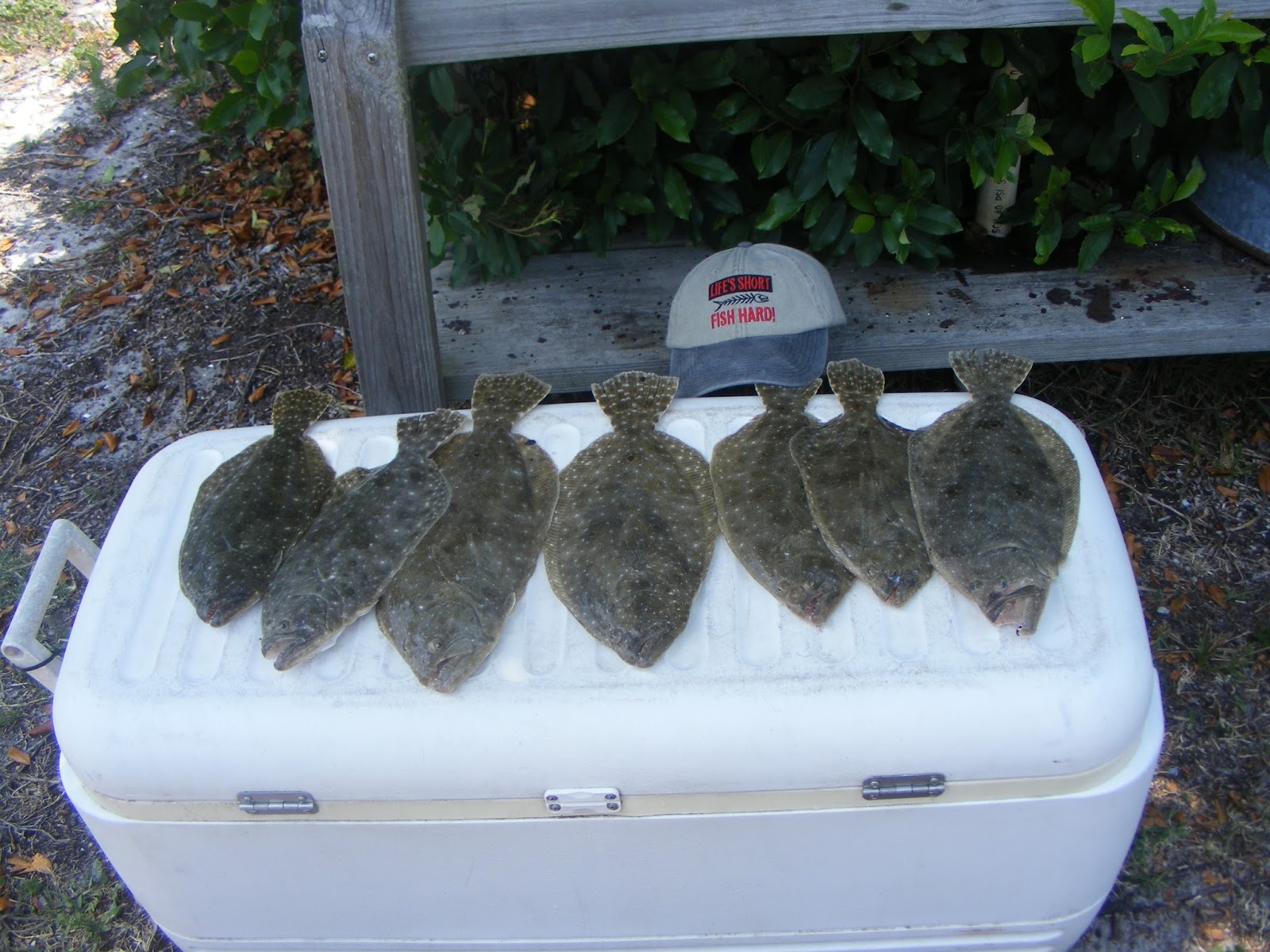
Just like that all thoughts of heat stroke melted away, and my only thought was to land this fish.  The fish was a flatty, or doormat, or flounder depending on where your from.   When hooked flounder tend to pull like a foul hooked trout, and this one was no different.  The fish squirreled up to the surface sideways, and I was able to land him.  Quickly I measured him, satisfied he was legal I threw him into the cooler, and quickly adjusted my lure.  Maybe, I thought, we could get on a few more. 
 
 
It was just my Dad and I cruising around Port St. Joe Bay in his 19 foot Sea Chaser.  We were employing one of my favorite techniques, the flounder drag.  The drag is quite a complicated process that involves casting out a D.O.A soft plastic shrimp, setting your rod in the rod holder, popping a cool beverage, and allowing your bait to drift in the current. 
 
The real secret to catching flounder this way is to find a patchy bottom of grass flats, which St. Joe Bay is perfect for.  Look for sandy potholes surrounded by grass, and your in business.   It's important not to anchor and just allow the boat to drift in the current. 
 
My favorite bait for this is a D.O. A. shrimp in white or natural colors, tied to a 7ft spinning rod using a loop knot.  The loop knot allows for a more natural movement of the bait.  I emailed Jerry McBride of D.O.A and asked him why the loop knot was so effective.  He replied,

 
"Unless it comes with a split ring, every lure I fish goes on with a loop knot. I twitch my baits rather aggressively, and the loop knot allows a great deal more life-like movement. Clinch knots and uni-knots are reliable, but if the knots cinches down tight on the hook-eye, the shrimp or jerkbait pretty much pops straight forward when I twitch it. Fished with a loop knot, our 3-inch shrimp, particularly, tends to plane up in the water column, does a hard left twist, suspends briefly, then dives back toward the bottom, perfectly emulating a shrimp, crab, or pinfish that's been spooked out of the grass or mud, and is now escaping back to cover. I've never found another lure that generates reaction strikes to this degree, and the loop knot really enhances the action." 


WELCOME


WELCOME TO THE SWAMP AND SEA SPORTSMAN BLOG SPOT


Deep in the heart of a cypress swamp where mosquitoes can be weighed in pounds and where red-eyed gators number in the hundreds I feel at home.  I enjoy the solitiude, the sights, and the smell.  I enjoy hunting lonely slough's, and fishing crooked rivers.  I get equally excited about paddling in a grassy bay surrounded by nobody, or fishing for giant kings and grouper offshore. 
 
The backwaters of South Georgia and the salty flats North Florida are where I like to spend my time. This blog is about my experiences in these forgotten places.  I hope everybody who stops and spends a few minutes reading my blog enjoys my stories.